
Podcast Guesting for Authors: 26 Proven Tips to Sell More Books Through Podcast Interviews
Based on Before the Bestseller by Alex Strathdee
Table of Contents
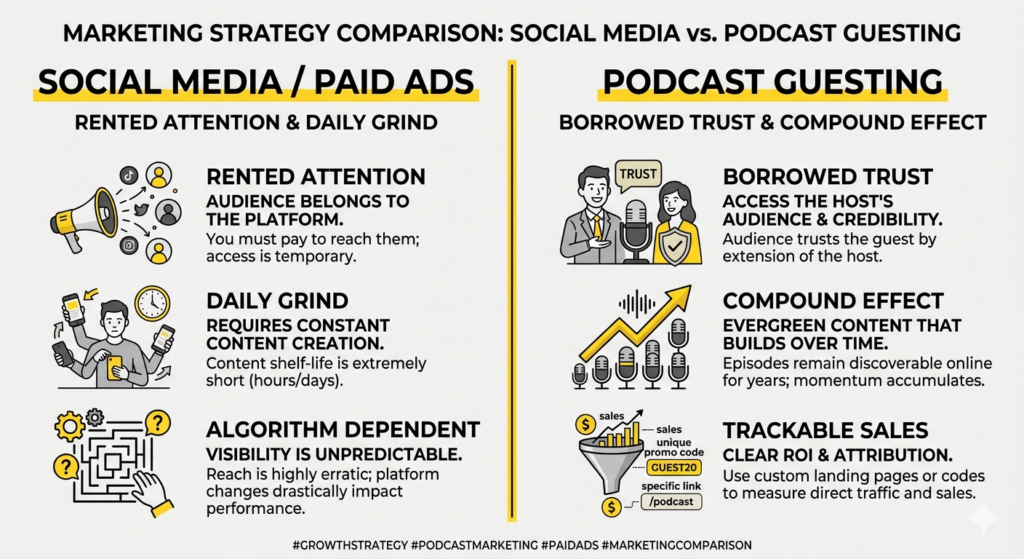
How Podcast Guesting Can Sell Books Better Than the Social Media Hamster Wheel
Most book marketing advice pushes authors toward an exhausting cycle: constantly feeding social media algorithms and pouring money into paid ads that stop the moment you stop paying. Podcast guesting flips that model entirely. Instead of renting attention, you borrow trust. Someone else has already built a loyal, engaged audience that chooses to listen for 30, 40, even 60 minutes. When the host hands you that trust, capturing the audience’s interest is more organic.
Three distinct advantages make podcast guesting a higher-ROI, lower-burnout channel compared to the typical social-media-and-ads grind:
Audience quality beats follower quantity. On social media, a post might reach thousands of passive scrollers without a single book sale. By contrast, a podcast with just 100 true fans who match your reader profile can generate 40 direct sales. Every listener who tunes in actively chose to be there, and the host’s personal endorsement bypasses the skepticism people feel toward ads or algorithmic content.
Sales impact is directly measurable. While social “success” is often measured in likes, shares, or impressions that don’t pay bills, podcast guesting leaves a clean data trail. Track your Amazon ranking or sales dashboard within 24–48 hours after an episode airs and you’ll see exactly which shows move copies. This lets you double down on what works instead of guessing which algorithm-blessed post did anything at all.
One interview may compound for years. Social content has a half-life of hours; paid ads disappear when the budget dries up. A podcast episode, however, lives in directories forever. Every new listener who discovers that episode next month or next year becomes a potential buyer, creating a long, passive sales tail that doesn’t demand your constant presence.
Finding & Qualifying the Right Podcasts
1. Target podcasts where both hosts and audiences match your ideal reader profile
Focus on shows where the host themselves would be interested in your book, as they’ll be more engaged during the interview. Even small podcasts with 100 engaged listeners who match your reader profile can yield 40 book sales, while misaligned audiences on major shows like Oprah may result in minimal sales despite massive exposure.
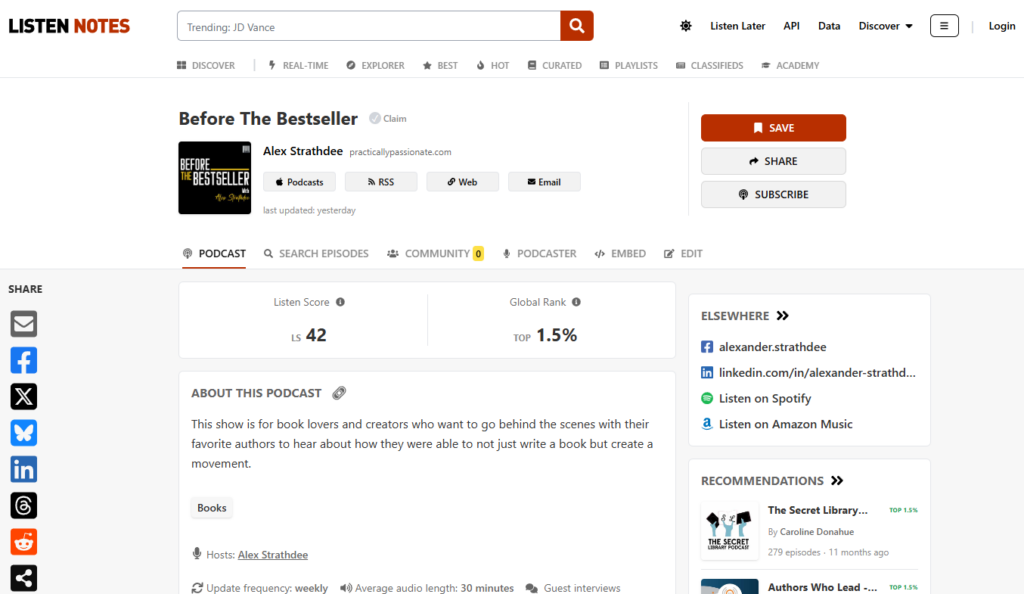
2. Research podcasts using ListenNotes.com or Refonic.com to identify quality opportunities
Use these platforms to find podcasts in your niche, focusing on shows in the top 1% for audience size. Research what podcasts your ‘author twin’ or competitors have appeared on to create a targeted list. Refonic provides more specific listener data than ListenNotes.
3. Focus on quality shows over quantity and avoid ‘garage podcasters’ with no audience
Be selective about interviews as each disrupts an entire week of productivity. Prioritize shows with proven audiences and hosts who match your ideal reader profile. Quality appearances on aligned shows drive more sales than quantity on mismatched platforms.
4. Get blurbs from previous guests of your target shows to strengthen pitches
If targeting a specific show, get editorial reviews or blurbs from their past guests. Including these in your pitch shows the host that trusted previous guests vouch for you, significantly increasing booking likelihood.
5. Expand beyond obvious niches by emphasizing different aspects of your story
When you exhaust podcasts in your primary niche, find creative angles to make your story relevant to other audiences. In one example, a wine author expanded to adventure/travel shows by emphasizing discovering wine while racing in Bhutan.
Pitching That Gets a “Yes” (Without Sounding Like a Spammer)
6. Leave reviews for shows before pitching and mention it in your outreach
Before reaching out to a podcast host, leave a positive review on iTunes or Spotify for their show. Include this in your pitch as it demonstrates you’re a genuine listener who has already provided value. You need to play an episode or two before platforms accept your review.
7. Create personalized video pitches under 60 seconds to double response rates
Record brief video introductions mentioning specific episodes you enjoyed and explaining how your content relates to their show. This personal touch significantly increases response rates compared to email-only pitches. Use Vimeo to avoid ads playing before your video.
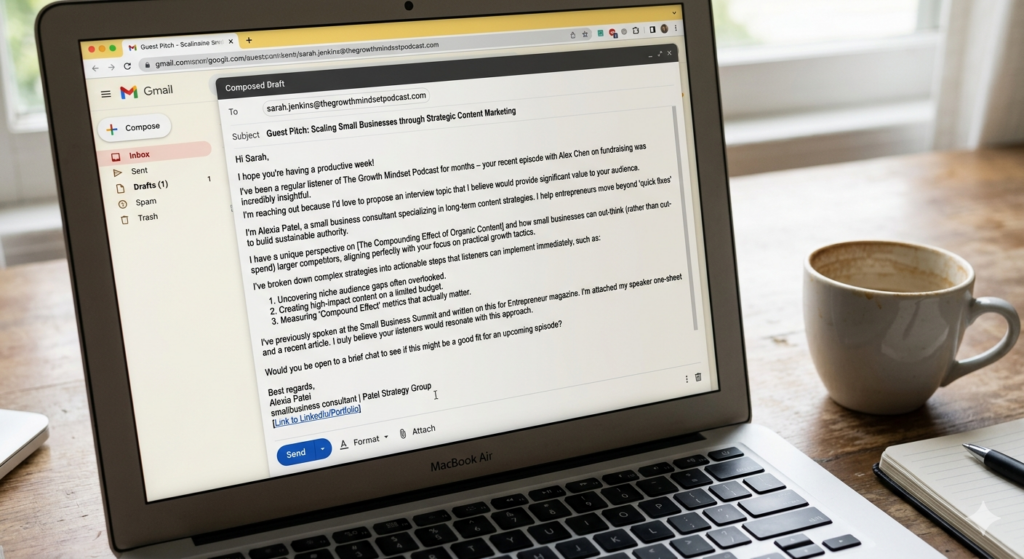
8. Include specific compliments and show you’ve listened to past episodes in your pitch
Genuine compliments must reference specific episodes or moments, not generic praise. Listen to 3+ episodes for high-value shows and mention personal connections like shared experiences or specific observations about the host’s style.
9. Pitch 20 podcasts per week to maintain consistent bookings
Maintain systematic outreach of 20 pitches weekly to compensate for natural rejection rates and ensure enough acceptances to meet your release schedule. This volume ensures steady appearances even with typical response rates.
10. Provide value first. Don’t directly promote your book during interviews
Focus on delivering massive value and actionable content throughout the interview. Let the host bring up your book at the end. This approach makes listeners think ‘if they gave this much value for free, imagine what’s in the book.’
11. Ensure your book link is always included in show notes
Listeners often check show notes while listening, making it crucial your book link appears there. Without it, conversion rates drop significantly as interested listeners can’t easily find your book while their interest is peaked.
12. Study each show’s format and customize your pitch accordingly
Research what types of episodes perform well, understand the show’s formula, and frame your pitch to match. Look at popular episode titles and propose similar angles that fit their established format while highlighting your unique value.
13. Use Mail Tracker to see if hosts opened your pitch emails
Mail tracker software or browser plugins show whether recipients opened your emails, helping determine if you need a better subject line or if the message itself needs improvement. It provides data to optimize your pitching approach.
14. Follow up through LinkedIn if email pitches are ignored
When email pitches go unanswered, reach out via LinkedIn where you may already be connected. Many hosts simply don’t see emails, making LinkedIn a valuable secondary channel for podcast outreach.
15. Split content into two episodes – one on book content, one on marketing
Propose a two-part series where the first episode covers your book’s content and the second discusses your marketing strategies. This doubles your exposure and appeals to different audience segments while providing more value.
Scaling Your Outreach Without Losing Quality
16. Ask every podcast host for introductions to two other podcast hosts
After each appearance, request introductions to two other shows. This creates a multiplication effect – from 5 podcasts you might get 10 introductions, leading to 5 actual introductions and 2 more bookings. This networking approach is more effective than cold pitching.
17. Schedule 4 podcast interviews to go live weekly for 10+ weeks after launch
Build a bank of 100+ recorded interviews before launch, then release 4 per week post-launch. This creates consistent exposure over months rather than a one-time burst, maintaining momentum and keeping your book visible to new audiences.

18. Hire a virtual assistant to handle podcast research and pitching
Have a VA search for 10 relevant podcasts weekly, research each show’s content and audience, and create personalized pitches. This ensures consistent outreach without burning out while maintaining quality. VAs can also send thank you notes post-interview.
19. Build your own audience before pitching to major podcasts
Big podcast hosts prefer guests with established followings who can cross-promote. Focus on building your email list, social media following, and content platform first. Include these metrics in your pitch to demonstrate mutual benefit.
20. Start pitching podcasts 1-6 months before your book launch
Begin outreach months in advance as shows often book guests 3-4 months out. Start with low-hanging fruit like shows you’re connected to via friends, then expand systematically. This timeline ensures episodes align with your launch period.
21. Use Podmatch or similar platforms to get booked efficiently
Services like Podmatch ($20-25/month) allow you to create a profile and get contacted by hosts looking for guests. This reverses the traditional pitching process and can result in numerous quality bookings with less effort.
Maximizing Every Appearance to Sell Books for Years
22. Use podcast appearances to gather content for articles and books while building relationships
Interview experts for your content while simultaneously recording for podcasts. This dual-purpose approach allows you to create articles for major publications while building your podcast presence and gathering material for future books.

23. Record interviews on your end to repurpose content across platforms
Ask to record podcasts locally so you can create clips for YouTube, social media, blogs, and your own content. This maximizes value from each appearance with only 10-20% extra effort, extending the interview’s reach.
24. Always mention a free lead magnet with a memorable URL at the end
Create downloadable resources related to your book and consistently mention them with tight, memorable URLs like yourname.com/podcastname. This captures email addresses from interested listeners for long-term relationship building.
25. Track sales spikes after each appearance to identify which shows drive actual sales
Monitor your Amazon ranking and sales data closely after each podcast airs. This helps identify which shows create visible sales spikes versus those providing only exposure, allowing you to prioritize future efforts on high-converting shows.
26. Continue podcast guesting years after launch for long-term sales
Successful authors maintain consistent podcast appearances long after launch. Set sustainable parameters like 2 podcasts per week maximum to avoid burnout while keeping your book visible. This creates steady sales over years rather than just launch spikes.
The Podcast Guesting Launch Timeline: From Zero to Sustained Book Sales
You don’t need to appear on 100 shows in a month. You need the right shows, at the right time, maintained consistently. Here’s how to phase your podcast guesting strategy so it builds momentum before launch, amplifies your book during the critical release window, and continues to sell copies for years afterward.
Phase 1: Pre-Launch (3–6 Months Before Release)
Goal: Secure a bank of recorded interviews ready to go live at launch.
Start building your podcast target list immediately. Identify shows your ideal readers listen to and begin listening to past episodes.
Begin pitching 20 shows per week, starting with lower-hanging fruit (warm connections, smaller aligned shows) and working up.
Aim to have at least 10–15 interviews recorded and banked before launch day. Many shows book 2–3 months out, so starting early avoids a dry spell when you need visibility most.
Use this phase to refine your pitch and messaging based on early feedback and acceptances.
Phase 2: Launch Window (Weeks 1–10 Post-Release)
Goal: Flood your target audience with consistent, overlapping exposure.
Schedule 4 podcast interviews to go live each week for at least 10 weeks after launch. This creates the perception of being “everywhere” in your niche without requiring a daily grind.
Ensure every episode’s show notes include your book link and a lead magnet URL to capture emails.
After each episode airs, track your Amazon sales rank or sales dashboard within 24-48 hours. Note which shows create visible spikes.
For high-performing shows, send a thank-you and propose a future second episode. For low-performers, simply log the data and deprioritize that audience segment in future outreach.
Phase 3: Sustain & Scale (Ongoing, Year After Year)
Goal: Turn a launch spike into a long-tail sales engine.
Maintain a sustainable cadence. Many successful authors cap at 2 podcast appearances per week to avoid burnout while keeping the book perpetually visible.
Repurpose every new interview into social clips, blog posts, and email content to feed your own platform without extra heavy lifting.
Use your tracking data to prioritize repeat appearances on the 20% of shows that drive 80% of sales. Let the data, not guesswork, dictate your calendar.
Continue pitching new shows, including those outside your immediate niche, using creative angles from your book’s themes to reach fresh audiences indefinitely.
Final Takeaway
Podcast guesting is not a launch-week sprint. It’s a permanent distribution channel for your book. Build the pre-launch runway, execute a focused launch window, and then settle into a rhythm that keeps selling books month after month, long after your last social media post has disappeared from the feed.